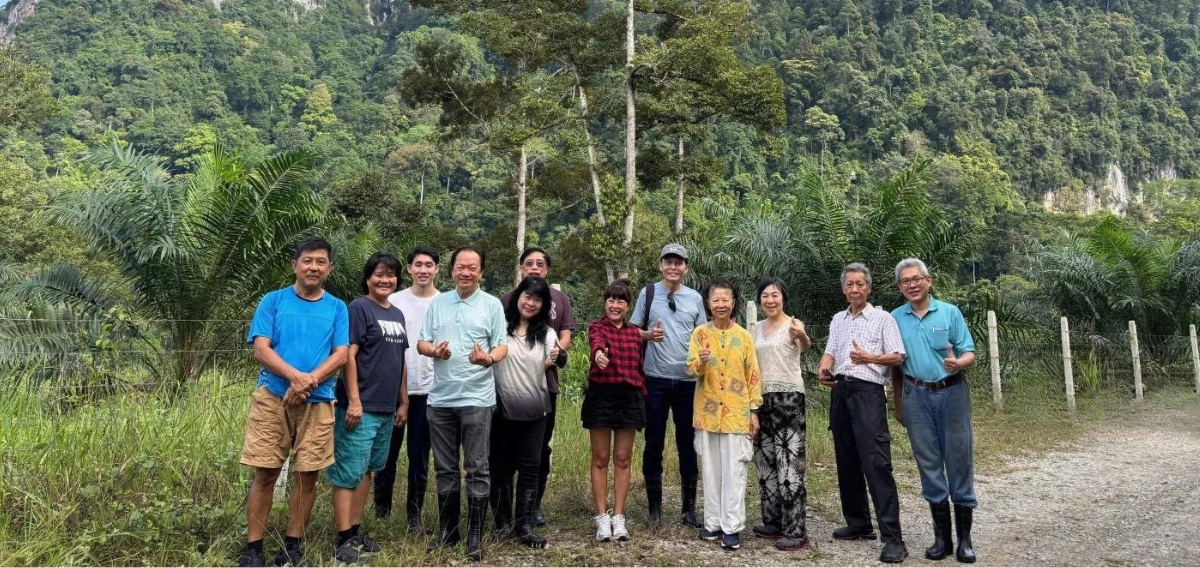
Wartime Stories: Hidden Places of Perak’s Darkest History. A Creative Reimagining based on the Chronicles of Gary Lit Ying Loong. Originally published by the NST Sunday Vibes Team • July 12, 2026
“HELP! Help… Help!” The desperate cries of terrified villagers pierced the heavy air, swallowed instantly by the roar of aggressive flames consuming their homes. In Kelang Kecil, Bidor, the Japanese Imperial Army had systematically sealed the doors and windows of frail attap-roofed houses, transforming sanctuaries into wooden furnaces before setting them ablaze.
Driven by suffocating smoke and blistering heat, those trapped inside flailed against the walls, frantically seeking an escape. A few managed to break through the fiery barriers, only to face the cold barrels of waiting soldiers. By the time the massacre subsided, Kelang Kecil was reduced to a desolate landscape of smouldering ash.
The nearby settlement of Samboling and the Orang Asli village of Kampong Senta met the exact same cruel fate. Today, these quiet, overgrown sites stand as solemn reminders of one of the absolute darkest chapters ever written in the history of the Kinta Valley.
Resistance on Bidor Hill
During the dark years of the Japanese Occupation, the dense, emerald canopies surrounding Blantan Peak on Bidor Hill sheltered a secretive world of resistance. Deep within these jungles, covert bases tied to the British Force 136 and the Malayan People’s Anti-Japanese Army (MPAJA) took root. The jungle, however, could not survive alone. Beneath the shadows of the peaks, local villagers engaged in their own quiet warfare, secretly funneling crucial food, harrowing intelligence, and endless logistical support to the guerillas. Inspired by the cause, many young men vanished from their homes, slipping into the thick wilderness to pick up arms against the occupiers.
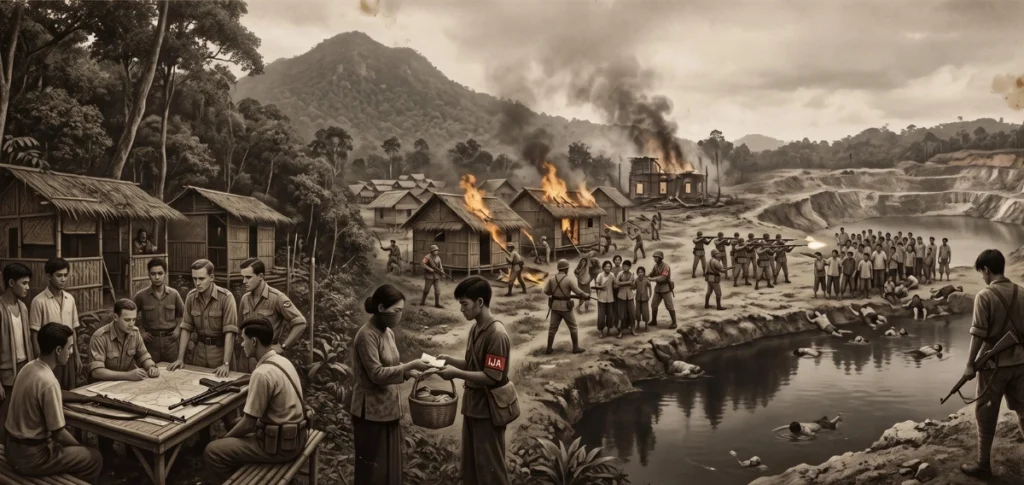
But secrecy in a time of terror is fragile. When Japanese forces uncovered these networks through local informers, their retribution was swift and unsparing. Entire villages were put to the torch, and mass civilian executions became the order of the day. At a local tin mine, the horror reached an unforgettable peak: hundreds of innocent workers and their families were corralled at gunpoint along the edge of a deep mining lake. The troops opened fire, and body after body tumbled lifelessly into the dark waters.
Yet, from the depths of this absolute slaughter emerged an unbelievable tale of survival. Decades later, during a lunch in Bidor, village chief Peter Chow recounted a fragment of living history passed down through his own family: “My brother-in-law was that baby,” he shared softly. The infant had been miraculously spared when a stray bullet merely grazed his tiny arm. His mother, overwhelmed by the sudden shock and believing her child dead, fainted instantly.
Together, they tumbled backward into the thick, wild undergrowth, hidden completely from the sweeping gazes of the executioners. “The baby wasn’t dead. He had only fainted from blood loss and pain,” Chow recalled. By absolute, brilliant chance, the very bushes that caught their fall became the veil that saved their lives.
Today, Samboling and Kelang Kecil are enveloped in silence, largely forgotten by the thousands of commuters who pass them daily, blissfully unaware of the immense suffering etched into the soil. Yet, these places remain vital landmarks of Perak’s wartime heritage. To honor these ghosts and retrace the historic trails—including the daring treks of British intelligence officer Freddie Spencer Chapman and his Force 136 comrades—a recent historical expedition was launched. Led by the author and comprising passionate members of the Peace Gallery, Perak Academy, YLCO Museum, and expert historians from Singapore, the journey sought not just to chart long-ago battles, but to remember the monumental endurance of the ordinary people who bore the true, crushing weight of the war.
The Blantan Agreement
The wartime alliance forged between the British Crown and the MPAJA was a fascinating, unlikely marriage of sheer convenience. Bound by a shared, ferocious enemy, British Force 136 provided high-grade weaponry, specialized tactical training, and crucial financial funding to the communist-led guerrillas. In return, the disciplined jungle fighters provided the local expertise and boots on the ground required to disrupt the Japanese war machine.
In his poignant book, ‘If the Sky Were to Fall…’, the author describes how his own father vividly remembered standing in the Tapah hills, watching massive white parachutes blossom against the sky, drifting down like ghosts over the ridges. Hidden beneath that silk were elite Force 136 agents, alongside vital crates of medicine, food, and lethal supplies to fuel the underground resistance. In the heart of the jungle, Spencer Chapman worked shoulder-to-shoulder with fellow officers Jim Hannah and Tham Sein Yen, mentoring the MPAJA in advanced jungle warfare and devastating sabotage techniques.
Chapman developed a profound respect for these fighters, marvelling at their ability to endure starvation, constant peril, and absolute exhaustion while maintaining unbreakable morale. He was particularly moved by the sight of young, orphaned guerillas—literal boys barely taller than the heavy rifles they carried. Stripped of their parents by the occupation’s cruelty, these children possessed an iron determination, forged in the fires of injustice, focused entirely on winning a better tomorrow.
Freddie Spencer Chapman: A Remarkable Survivor
When the initial British lines collapsed and forces withdrew during the sudden Japanese invasion of Malaya, Freddie Spencer Chapman refused to leave. He chose instead to step into the shadows and stay behind. Operating deep within hostile, enemy-controlled territory, he became a phantom, conducting high-stakes sabotage operations against vital Japanese supply lines and infrastructure. He survived near-impossible odds, slipping away from countless traps, ambushes, and capture attempts.
Remarkably, despite living under a constant sentence of death, Chapman never lost his deep, almost spiritual appreciation for Malaya’s natural beauty. In his legendary memoir, ‘The Jungle Is Neutral’, he penned beautiful observations of the ancient forests, the vibrant wildlife, and the unexpected moments of peace he found while hiding in the bush. Yet, his writings were equally a ledger of sorrow.
From his hidden vantage points in the jungle canopy, the distant, terrible sounds of violence against innocent civilians echoed clearly—haunting auditory scars that would follow him long after the global conflict drew to a close. For Chapman, the jungle was never just a battleground; it was a profound theater where humanity’s worst cruelties met its most radiant resilience.
Tapah Police Station: A Tense Surrender
In August 1945, the historic radio broadcast of Emperor Hirohito announced the total surrender of the Japanese Empire. Emerging from their hidden redoubts on Bidor Hill, Force 136 officers Jim Hannah and Tham Sein Yen marched alongside a contingent of MPAJA guerillas into the town of Tapah, intent on securing the local police station. However, peace would not come easily. Inside, the fanatical Japanese Kempeitai military police dug in their heels, flatly refusing to surrender their weapons and triggering an incredibly tense, razor-edge standoff.
The explosive situation was ultimately defused through the masterful, icy negotiations of Hannah and Tham. Refusing to back down, Hannah commandeered the vehicle of the feared Kempeitai commander, Major Onishi, ordering the officer to drive him directly to the regional command in Ipoh to demand a formal, comprehensive surrender from the highest Japanese authorities. Before departing into the unknown, Hannah delivered a chilling, unambiguous warning to the remaining garrison: if he did not return alive and unharmed, the Japanese troops trapped in Tapah would face total, immediate annihilation.
Temoh: A Tragedy at The End of The War
While the standoffs in Bidor and Tapah were resolved without further bloodshed, the nearby town of Temoh was destined to bear witness to a horrific final atrocity, executed in the dying, desperate hours of the occupation. Expecting a peaceful transition of power, several young MPAJA guerillas openly approached the Temoh police station. Instead of raising a white flag, the entrenched Japanese officers and collaborated local police unleashed a sudden, devastating volley of gunfire.
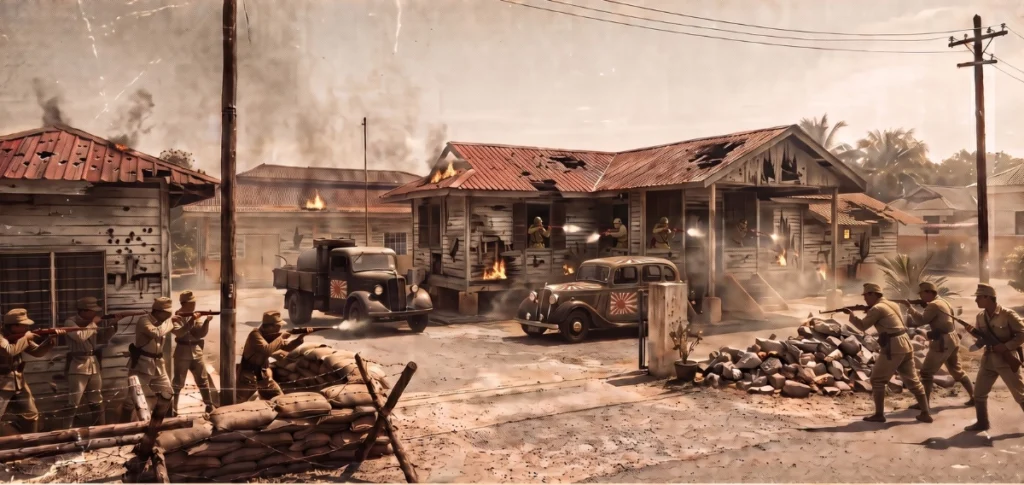
Living in a house directly adjacent to the station, the author’s 96-year-old aunt, Yigu, saw the entire nightmare unfold. Visiting Temoh recently, she recalled the scene with trembling clarity: “I saw blood streaming down the legs of the three young guerillas after the gun battle. Even though they pleaded for mercy, the Japanese buried them alive beneath a rambutan tree opposite the station.” She paused in the middle of her retelling, visibly shaken as the decades-old horror rushed back. Terrified of immediate military reprisal, the local families could only watch in agony, waiting weeks until the British military officially returned before daring to unearth the shallow grave and give the boys a proper, dignified burial.
Today, their sacrifice is commemorated by a modest “Three Star” tomb. Yigu’s storehouse of memories also held horrors from the Kampar police station. She detailed how local townspeople were routinely corralled into public spaces to witness brutal executions carried out by Japanese soldiers. In a display of psychological cruelty, victims were forced to dig their own burial pits before being executed on the spot. These oral histories, kept alive by aging survivors, offer an invaluable, deeply personal window into the absolute terror and daily uncertainty that governed civilian life under the occupation.
Kampar: Battlefield & Terror
The historical expedition moved next to Kampar, visiting ACS Kampar—the author’s own alma mater. In December 1941, the sprawling school grounds had served as a bustling military encampment for British troops preparing for the monumental Battle of Kampar. This clash would go down in history as one of the most stubborn, brilliant defensive stands mounted by British and Commonwealth forces during the entire ill-fated Malayan campaign. Perched strategically on the surrounding ridges, the Allied soldiers successfully repelled wave after wave of ferocious Japanese assaults for days, buying crucial time before executing a tactical withdrawal.
Standing within the quiet expanses of the Kampar Chinese cemetery, the author pointed out the sweeping, panoramic view of the Kinta Valley. This exact vantage point allowed British artillerymen and machine-gun crews to rain devastating, highly effective fire upon the advancing Japanese divisions. The scars of that historic clash remain visible even today: anyone who explores Kampar Hill can still stumble upon the fading contours of combat trenches, rusted ammunition remnants, and shattered aircraft wreckage. Yet, the war was not confined to conventional frontlines; for the civilian population, a parallel, insidious reign of terror was unleashed daily by the military administration against anyone suspected of aiding the jungle resistance.
Shadow of Sook Ching
The author’s father summarized the grim reality of the occupation in four simple words: it was “hell on Earth.” During the infamous Sook Ching purges, a network of treacherous local informers was weaponized to identify anyone harboring anti-Japanese sentiments. Across the length and breadth of Malaya and Singapore, Chinese communities lived in a state of perpetual dread as sudden arrests and arbitrary executions shattered families overnight. In Kampar, this terror manifested on the padang right beside ACS Kampar. Thousands of anxious residents were rounded up and packed onto the field, subjected to rigorous, terrifying screenings and aggressive interrogations. A single, anonymous nod from a hooded informer was all it took to seal a person’s fate permanently.
During the expedition’s visit, the current school principal, Hardave Singh, shared a contemporary, eerie manifestation of this heavy history, noting his experiences while working late on the historic campus. “Sometimes I hear chairs moving and see lights flickering even though nobody is there,” he remarked. Whether these occurrences are merely the natural settling sounds of an aged structure or the literal, restless echoes of a traumatized past, they reflect how profoundly wartime memory remains woven into the physical architecture of these towns. The Sook Ching operations left deep, indelible scars across generations, remembered vividly by survivors like Chang Loy, who witnessed the horrors as a young child in Rembau and carried the emotional weight for the rest of her days.
Sahom: A Temple of Memory
Deep in Sahom, the expedition visited a quiet temple that serves as a sacred mausoleum for a forgotten tragedy. Local lore tells of a group of terrified villagers who sought refuge within a nearby cave, only to be discovered by a passing Japanese patrol and massacred in cold blood. Once the tides of war receded, their scattered remains were lovingly gathered by survivors and placed within a ceremonial urn, resting beside a shrine dedicated to Guan Yin, the Goddess of Mercy.
This sacred site once housed a magnificent, historic bronze bell, originally cast over a century ago during the prestigious reign of the Guangxu Emperor—a priceless relic tracing back to Imperial China. Though the bell was stolen by modern thieves years ago, it was miraculously recovered following the spiritual guidance of a temple medium. During the visit, the expedition members took turns striking the heavy bronze three times. As the deep, resonant tones reverberated through the valley, they offered silent prayers for eternal peace and the repose of the souls who suffered there.
A short distance away, the group stepped into the pitch-black maw of an underground cave once utilized as a covert base by guerillas during both World War II and the subsequently bloody Malayan Emergency. The oppressive dampness offered a visceral taste of the brutal, claustrophobic conditions endured by those who lived and fought in total secrecy. A veteran guerrilla’s fierce words still echo through history: “The Japanese dared not enter our caves. We would be waiting for them with our guns. Masuk satu, mati satu!” (“Enter one, die one!”)
Memories Beneath The Silence
The formal surrender of Japan in 1945 brought no permanent peace to Perak; the state’s ancient jungles quickly transformed into bloody battlegrounds once more during the prolonged Malayan Emergency. The peaceful sports field beside ACS Kampar was re-engineered into a frantic military staging hub. British helicopters roared overhead, delivering troops into the dense interior, while a steady stream of ambulances rushed wounded soldiers—shattered by hidden landmines and vicious booby traps—to nearby field hospitals.
Decades later, during the outbreak of the Second Emergency, the author’s late brother, Royal Malaysian Air Force fighter pilot Captain Lit Ying Wai, flew dangerous combat missions against communist strongholds tucked away in northern Perak and Kedah. When he had first joined the ranks, their father harbored a deep, agonizing fear: that the cruel ironies of civil conflict might one day force his pilot son to open fire on a childhood friend who had chosen the path of the communist insurgency.
Despite these heavy family anxieties, Captain Lit excelled in his military career, earning a coveted selection for prestigious overseas pilot training. Tragically, his life was cut short not in the skies, but in a fatal car accident. Today, ACS Kampar keeps his memory alive through the Captain Lit Memorial Scholarship Fund, ensuring his legacy continues to support bright, deserving students.
Conventional history books and big-budget war cinema frequently glorify high-ranking military strategists and dramatic battlefield triumphs, yet the quiet voices of ordinary citizens are easily swept aside. The brave villagers who sustained the jungle resistance were far more than helpless casualties; they knowingly placed their lives and the lives of their families on the line to smuggle food, shelter, and actionable intelligence to the fighters. Many paid the ultimate price for that quiet defiance. Their stories deserve to be etched alongside the household names of celebrated war heroes.
Retracing the footsteps of Freddie Spencer Chapman through the wild terrain of Perak is far more than an academic exercise in wartime geography. It stands as a powerful testament to the courage, extreme hardships, and anonymous sacrifices of thousands whose names will never grace a formal monument.
Today, the abandoned settlements, the dark limestone caves, and the forgotten graves scattered across the Perak landscape are wrapped in a deceptive, beautiful peace. Yet, beneath that profound silence beat the memories of a shattered generation that survived the unthinkable—a permanent, living reminder that peace is a fragile gift, and one that must never be taken for granted.
About the chronicler:
Gary Lit Ying Loong is a distinguished retired academic from Nanyang Technological University (NTU), Singapore. He currently serves as a visiting professor at several prestigious universities across Asia and Europe. He can be reached for historical inquiries and correspondence at garylit33@gmail.com.